


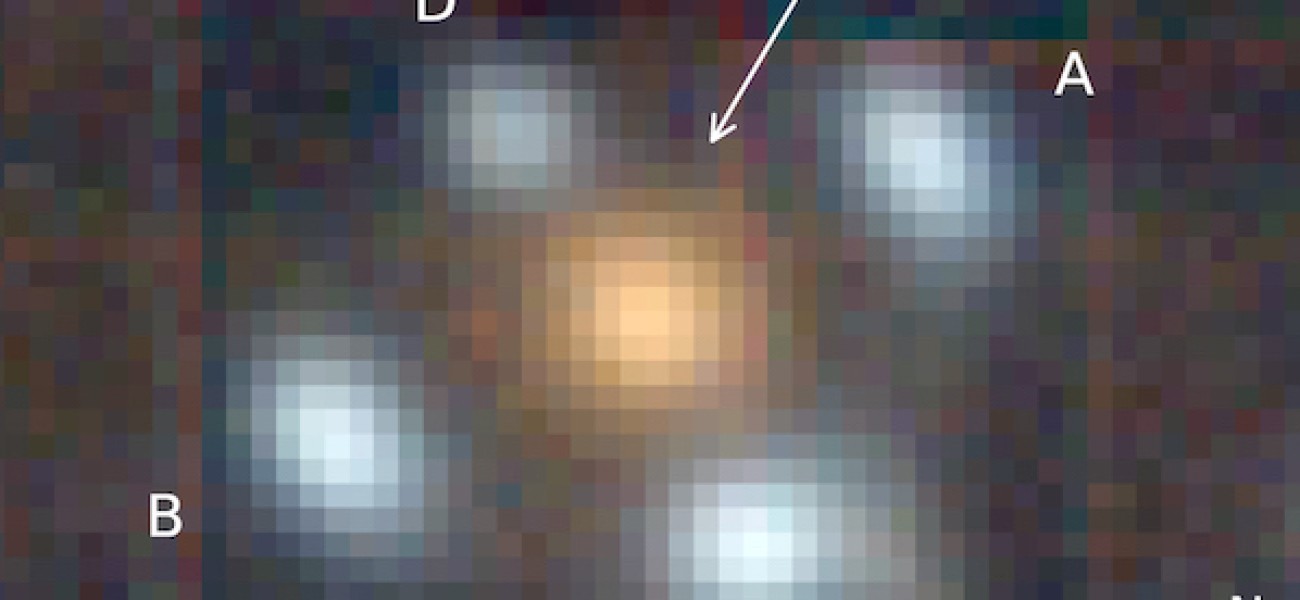
Light bent by the gravity of a massive object can project four images of a distant galaxy in a cross-shaped configuration. - Credit: Aleksandar Cikota, et al, and ESO/VLT/MUSE
Science breakthrough
Using the GIGA-Lens modeling code on the Perlmutter supercomputer at NERSC, a team of researchers has modeled a rare instance of strong gravitational lensing known as an Einstein Cross – likely the first such system to be modeled on graphical processing units (GPUs) and a demonstration of the promise of GPU-accelerated modeling. Their research was published in The Astrophysical Journal Letters.
Science background
Gravitational lensing occurs when the gravity of a massive object warps space-time in such a way that the path of light from a more distant source bends, sometimes producing multiple images of the source. It’s a powerful tool for astronomers and cosmologists studying dark matter since it can help researchers understand the location and distribution of dark matter not easily detected in other ways. When the mass acting as a lens is elliptically distributed, and the alignment of the light source is just right, a cross pattern of four images with the identical color of the source appears: the Einstein Cross.
Science breakdown
Researchers identified this gravitational lensing system, DESI-253.2534+26.884, in the data from Dark Energy Spectroscopic Instrument (DESI) Legacy Imaging Survey using deep neural networks, then modeled it on Perlmutter using GIGA-Lens, a Bayesian lens modeling pipeline. The system is believed to be the first real gravitational lensing system modeled with GPUs; on a single A100 GPU, the model was completed in 55 seconds, a drastic reduction from the average of 4.3 hours reported in a previous study. Modeling the system on a single node of four GPUs, the paper’s authors believe the modeling time could be reduced even further to 15 seconds.
Research lead
Aleksandar Cikota, NOIRLab
Coauthors
I. Toro Bertolla, X. Huang, S. Baltasar, N, Ratier-Werbin, W. Sheu, C. Storfer, N. Suzuki, D.J. Schlegel, R. Cartier, S. Torres, S. Cikota, E. Jullo
Publication
Cikota, A., et al. “DESI-253.2534+26.8843: A New Einstein Cross Spectroscopically Confirmed with VLT/MUSE and Modeled with GIGA-Lens”
Aleksandar Cikota et al 2023 ApJL 953 L5
Funding
The U.S. Department of Energy, Office of Science, Office of High Energy Physics partially funded this work.
User facilities
National Energy Research Scientific Computing Center (NERSC)
About NERSC and Berkeley Lab
The National Energy Research Scientific Computing Center (NERSC) is the mission computing facility for the U.S. Department of Energy Office of Science, the nation’s single largest supporter of basic research in the physical sciences.
Located at Lawrence Berkeley National Laboratory (Berkeley Lab), NERSC serves 11,000 scientists at national laboratories and universities researching a wide range of problems in climate, fusion energy, materials sciences, physics, chemistry, computational biology, and other disciplines. An average of 2,000 peer-reviewed science results a year rely on NERSC resources and expertise, which has also supported the work of seven Nobel Prize-winning scientists and teams.
NERSC is a U.S. Department of Energy Office of Science User Facility.
Media contact: Email our communications team ⟶