Investigating Automatic Differentiation in Blast/WarpX

Science/CS domains
High performance computing (HPC), machine learning (ML), accelerator, plasma, and beam physics
Project description
NERSC is seeking an enthusiastic summer-plus intern for a term of up to six months to investigate integrating the Enzyme Automatic Differentiator into the Gordon-Bell award-winning PIC code, WarpX, and its sibling code ImpactX.
The results of this internship will contribute to production-quality, daily-use open source modeling software with a direct impact on next-generation particle accelerators and fusion energy science research.
Background
When designing novel particle accelerators, such as the beamlines driving the latest Neutrino experiments and compact laser-plasma accelerators for novel light sources, a large number of variables must be considered to produce high-quality, high-charge, high-energy particle beams. To produce these beams, an initial set of parameters is chosen, and a simulation is completed to calculate the relativistic physics and non-linear dynamics in an accelerator. An optimization strategy, such as conjugate gradient or Bayesian Optimization, is then applied to produce a new, improved prediction of the most likely parameter values that yield the desired beam. The simulation is then run again with the new parameters. This is repeated until appropriate parameters are identified that reliably produce the desired particle beam.
The Beam, Plasma & Accelerator Simulation Toolkit (BLAST) team, in close collaboration with NERSC, is investigating the use of automatic differentiation to improve the time-to-solution for WarpX/ImpactX simulations in high-energy physics, with an overarching impact on high-energy physics and fusion-energy science challenges. Automatic differentiation (AD) tools, like Enzyme, instrument specific pieces of a scientific code to automatically track the influence and sensitivity of important simulation parameters.
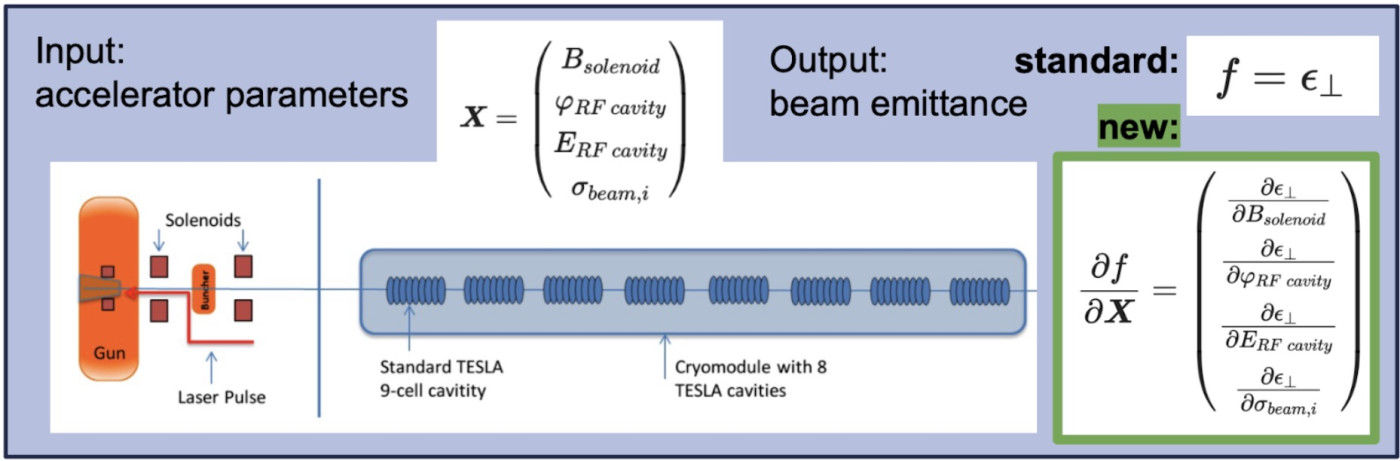
Novel beamline accelerator physics present high-dimensional optimization problems. This illustration shows an example beamline setup for this project, including possible variables for optimizing the beam.
Specifically, AD calculates the relationship between changes in input variables and returns the corresponding derivatives. These derivatives can be used by optimization strategies to greatly improve their parameter guesses, thereby reducing the number of simulations needed to find the beam parameters. And, gradient tracking provides the basis for innovative ML workflows, such as training embedded neural networks in high-performance simulations.
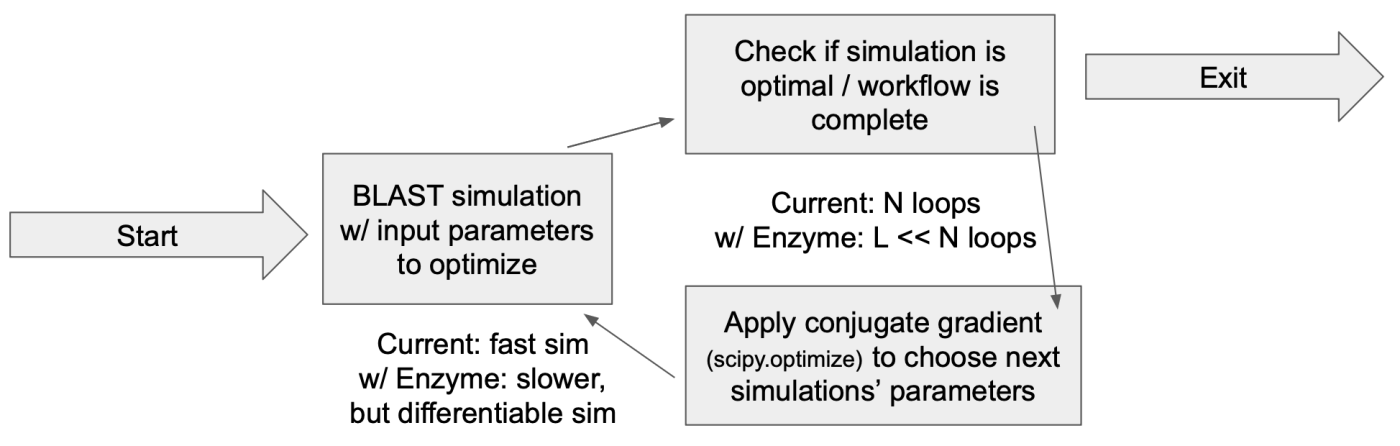
Enabling AD in BLAST slows individual simulations (by capturing simulation results and their gradients), but reduces the number of simulations needed, producing an overall savings (time-to-solution/GPU-hours) for high-dimensional optimization problems, as in accelerator physics.
Project tasks
Time permitting, some specific research steps targeted for this internship include the following:
-
From existing prototypes in ImpactX with Enzyme support, widen support for features and close gaps in Enzyme C++ feature support, implement new tests and enhancements in Enzyme, and push these features into ImpactX and WarpX.
-
Validate updates to Enzyme in BLAST codes ImpactX/WarpX.
-
Propose a user-friendly integration into BLAST codes.
-
Build tests and continuous integration.
-
Communicate current status and results in team meetings, talks and/or academic poster/paper, as applicable.
Desired skills/background
- Experience with C++ and Python
- Strong interdisciplinary communication and teamwork skills
- Experience with compilers/compiler tools, especially LLVM compilers
- Experience performing scientific and/or computational science research
- Experience with automatic differentiation tools or theory is desired, but not necessary
- Experience with CUDA, OpenMP, and/or MPI would be a plus
Apply to join this project
To apply or ask a question about this project:
Project mentors

Rahulkumar Gayatri
Computer Systems Engineer 4
National Energy Research Scientific Computing Center (NERSC)
HPC Technology Dept.
Programming Environments & Models Group

Kevin Gott
Computer Systems Engineer 3
National Energy Research Scientific Computing Center (NERSC)
Science Engagement & Workflows Dept.
User Engagement Group

Brandon Cook
Programming Environment & Models Group Lead
National Energy Research Scientific Computing Center (NERSC)
HPC Technology Dept.
Programming Environments & Models Group
Axel Huebl
Physics Research Scientist/Engineer
Accelerator Technology & Applied Physics Division (ATAP)
Advanced Modeling Program