Fault-Tolerant Clifford Circuits: Theory to implementation
Science/CS Domain(s)
Quantum Error Correction (QEC), Quantum Circuit Simulation, Fault-Tolerance
Project description
Quantum computing is evolving from static logical qubits to their active use in computation. While experiments validate “quantum memory,” entangled operations introduce challenges often overlooked in benchmarks. This project aims to analyze how selected CSS codes (e.g., Steane, Bacon-Shor) execute non-trivial Clifford circuits, quantifying trade-offs in syndrome extraction overhead, circuit depth, and logical fidelity under realistic noise conditions. Utilizing the Stim stabilizer simulator, the project will construct logical qubits and implement fault-tolerant protocols by designing transversal implementations of key algorithms (e.g., GHZ, Bernstein-Vazirani, Teleportation). Monte Carlo simulations will be employed to assess performance, focusing on logical error rates and thresholds to bridge theoretical concepts with practical implementation, thereby enhancing the understanding of encoded qubit performance in complex operations as quantum hardware matures.
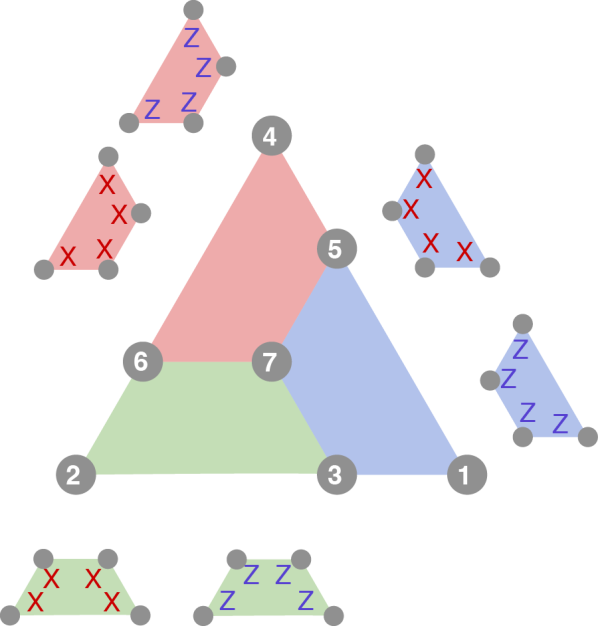
Stabilizer generators of the Steane code - Credit: https://errorcorrectionzoo.org/
Project tasks
- Develop Logical Architectures: Implement and validate QEC codes using simulation tools, establishing control structures for logical information.
- Scale to Multi-Qubit Systems: Extend implementations to include entangled logical qubits, with a focus on fault-tolerant gates for multi-qubit interactions.
- Implement Benchmarking Circuits: Encode representative quantum algorithms and primitives onto the logical architecture to test system capabilities.
- Performance Analysis: Analyze logical fidelity through high-volume simulations, evaluating trade-offs between overheads, complexity, and the threshold where logical performance exceeds physical baselines.
Desired skills/background
- Strong foundation in QEC (stabilizers, CSS codes).
- Python proficiency; Stim familiarity preferred.
- Experience with AI reasoning engines (e.g., ChatGPT) and AI-augmented IDEs (e.g., Cursor).
- Graduate-level QEC coursework or equivalent.
References
[1] Fault-Tolerant Quantum Computing with CSS codes
[2] Gidney, C. (2021). “Stim: a fast stabilizer circuit simulator.”
Apply to join this project
To apply to or ask a question about this project:
Project mentor

Jan Balewski
Staff Data Scientist
National Energy Research Scientific Computing Center (NERSC)
Science Engagement & Workflows Dept.
Data Science Engagement Group